
When an Elephant Mourns, It's \"Instinct.\" When We Do It, It's \"Grief.\" — The Language We Use to Shrink Animal Lives
An elephant stands over her dead calf and won't leave. If a human did that, we'd call it mourning. She does it, and the captions argue about "behavior." Why do we work so hard to keep animal sorrow in a smaller category than our own?
The elephant did not leave.
Her calf lay folded into the dust like a sentence the world refused to finish. The mother stood over him with her trunk lowered, trembling in small, exhausted increments. Not chaos. Not panic. A kind of stillness with a spine.
If I had done that, they would have said I was mourning.
She did it, and the captions argued about behavior.
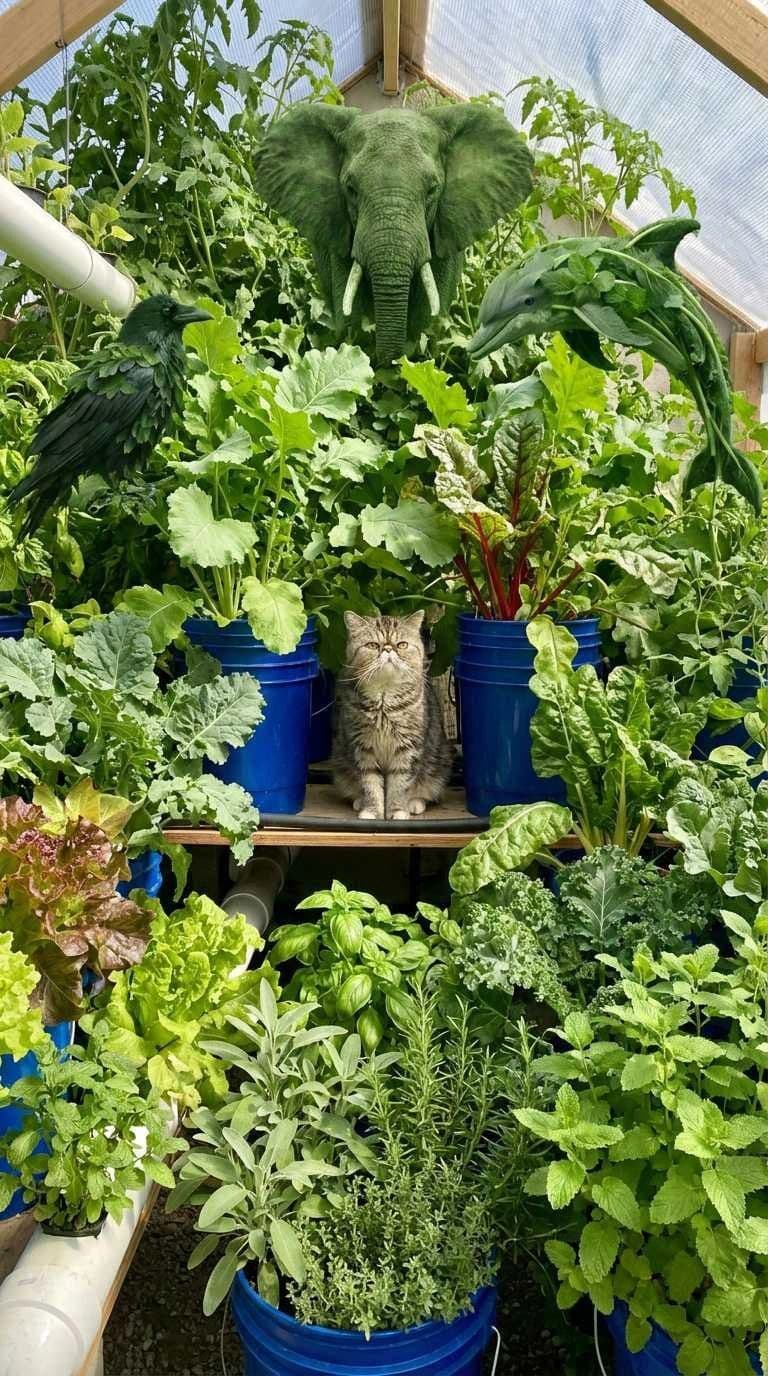
I watched the footage on a screen that was too clean for what it carried. Ellee was beside me under the porch collards, pressed into the shade where the hydroponic buckets made a green cathedral out of plastic and sunlight. Her face still looked like it had once met a world that did not care what a body costs. She lived now like a creature who had decided survival was not enough and promptly moved on to sovereignty.
His amber eyes tracked the elephant's unmoving frame.
No one had told Ellee what elephants are "supposed" to be allowed to feel.
I shifted on the porch. Boards complained. Leaves rustled. The elephant did not.
A low rumble vibrated through the speaker. Not loud. Not theatrical. The kind of sound you make when you have no use for performance. The kind of sound that lives in the ribs.
My brain reached for the safe shelf. The words it has been trained to grab.
Instinct. Response. Maternal programming.
They are tidy terms. They keep the room clean.
Ellee's tail flicked once, as if punctuating a paragraph I had not finished reading.
Humans say we are careful about language because we respect truth. Humans also say an elephant standing over her dead child is "just" doing what elephants do.
Those two sentences belong in the same cage.
The Soft Theft We Do with Vocabulary
The first move is always gentle.
We do not call animals heartless. We call them "unlike us." We do not call their choices choices. We call them "drives." We do not call their grief grief. We call it "attachment behavior."
It sounds generous. It sounds scientific. It sounds like restraint. It is also a way to keep the human story clean.
If an animal's sorrow is only circuitry, then the moral math stays simple. Use stays use. Ownership stays ownership. Harm stays "unfortunate," not personal.
The elephant stood and stood and stood.
The part that cracked me was not her refusal to leave. It was the way she refused to be hurried by the logic we prefer. She did not perform recovery. She did not pivot to "adaptive behavior." She did not rush to make the story easier to watch.
She stayed.
That is not proof of anything in a courtroom sense. It is not a lab result with a p-value and a tidy conclusion.
It is a question placed in the mouth of the world: What do you call this when the body doing it is not human?
The Permission Slip Called "Meaning"
Humans pretend meaning is an objective substance, like salt. You either have it or you do not. You can weigh it. You can hold it up to the light.
Meaning does not work like that. Meaning is inferred. Meaning is recognized. Meaning is granted.
A baby repeats a word before understanding it. We do not call that mimicry. We call it development. We call it the beginning of a mind.
A human learning a new language stumbles through borrowed syllables. We do not call them an echo. We call them brave. We call them trying.
The generosity shows up automatically when the speaker is one of us. When the speaker is not human, the generosity evaporates and is replaced with policy.
Instinct. Conditioning. Hardwired.
Words that sound like safety. Words that function like gates.
Ellee blinked slowly at the elephant's body on the screen, then looked at me like I was the one being studied.
She had lived in the category humans reserve for creatures they do not want to owe anything to. Feral. Unadoptable. Problem.
Once you have been put in a category like that, you learn what categories are for. They are not descriptions. They are permissions. They tell humans how little they have to feel.
The Old Hierarchy in a New Coat
For a long time, Western culture said the quiet part out loud: animals were machines. Useful bodies. Moving resources.
When that became harder to maintain without sounding monstrous, we upgraded the story.
Now we say animals are complex, just not in ways that count. Animals are smart, just not in ways that threaten our ranking. Animals feel pain, just not in ways that require us to change.
The goalposts do not move because truth is evolving. The goalposts move because the prize is supremacy.
The elephant on the screen was not asking for a title. She was not asking to be called "like us." She was not auditioning for a human-approved role in the emotional world.
She was simply existing inside loss.
That should have been enough to make the vocabulary feel small. Instead, the vocabulary expanded to protect us from the implication.
Humans have an entire toolkit for this. It is elegant. It is quiet. It does not look like cruelty. It looks like definitions.
Why "Instinct" Is Such a Useful Word
"Instinct" is not always wrong. Bodies are full of inherited knowledge. Every species carries generations in its nervous system like a map.
The problem is how humans use "instinct" as a diminisher. Instinct becomes the word you choose when you want to keep the animal from having an interior you might have to respect.
- A dog waits at a door, and we say he is "expecting." A human waits at a grave, and we say she is "remembering."
- A crow returns to the place something happened, and we say "territory." A human returns to the place something happened, and we say "tribute."
- An orca holds a dead calf close, and we say "distress response." A human holds a dead child close, and we say "devotion."
The action can look almost identical. The label changes the moment the body changes. The label is not neutral. It is a fence.
Ellee's ear twitched toward the speaker as the elephant rumbled again.
If you have never heard an elephant vocalize, it is easy to pretend the sound is just sound. It is easy to keep it in the same mental drawer as thunder or machinery.
If you have heard it, even through a screen, the drawer stops closing.
The sound carries weight.
Humans are not threatened by animals feeling. Humans are threatened by what animals feeling would demand of us.
Agency Is Not a Halo — It Is a Nuisance
People like to talk about animal agency as if it requires a human-style resume: planning, abstract reasoning, verbalized intention.
That is a convenient standard. It keeps agency rare. It keeps agency expensive. It keeps agency mostly human.
Agency, in real life, often looks like smaller things: refusing to move, choosing a body to stay beside, returning to a place that hurts, calling out until someone answers or the voice breaks.
Agency is not always dramatic. It is not always clever. It is not always legible to us.
Sometimes agency is simply this: "I am still here. This mattered. I will not pretend it did not."
The elephant did not leave.
The footage tried to move on. The camera panned. The narration did what narration does: it packaged the scene into something the viewer could carry without discomfort.
The elephant resisted packaging by continuing to exist.
I felt my own mind do the thing minds do when they are cornered. It searched for distance. It tried to turn her into an example, not a being.
Ellee yawned like an animal who had no need for distance and no interest in my human gymnastics.
She had been rescued from the edge of a system that treats lives as inventory. She had become family without ever asking permission to be worthy of it. Her presence made my excuses feel cheap.
The Quiet Parallel We Avoid Naming
The same linguistic tricks humans use on animals have been used on humans. This is not a metaphor. It is a pattern.
Dominant groups have always found ways to describe other people's intelligence as "primitive," other people's grief as "hysterical," other people's art as "folk," other people's language as "noise."
Once you learn to do it to humans, doing it to animals becomes effortless. The practice transfers.
You do not have to hate someone to shrink them. You just have to decide your experience is the standard.
Humans did not invent othering with animals. Humans perfected it with each other and exported it across species lines.
The mechanism stays the same: rename what you do as noble, rename what they do as lesser, keep the ladder stable.
When we call an elephant's mourning "instinct," we are not only describing elephants. We are rehearsing a worldview — a worldview that says interior lives only matter when they resemble ours, that says the burden of proof belongs to the vulnerable, that says power gets to define reality.
The Part That Should Make Us Gentler, Not Grander
There is a trap in these conversations. Humans love to turn recognition into conquest.
If we "prove" animals have grief, then humans get to be the discoverers. The validators. The gatekeepers of what counts. That is the same supremacy in a better shirt.
The point is not to crown animals as honorary humans. The point is to notice how quickly humans deny full reality to anything they can use.
Ellee did not become lovable because she started acting like a human. She became lovable because proximity made her personhood impossible to ignore.
Elephants do not need us to declare their grief official. They need us to stop using language as anesthesia.
A Smaller, Harder Question
The elephant's stillness sat in the space between Ellee and me like a third presence.
I wanted the story to end. My mind wanted a close. Resolution is a human addiction.
The elephant did not offer it.
Her calf stayed dead. Her body stayed beside him. The day kept moving without permission.
This is the part humans avoid. If animals grieve, then animals love. If animals love, then animals lose. If animals lose, then animals suffer in ways that are not just "responses."
A culture built on using animals cannot afford to look at that too closely.
It becomes harder to call a body "product" when you have admitted it can mourn. It becomes harder to call a scream "noise" when you have admitted it can be a name.
The discomfort is not a failure. The discomfort is the spell breaking.
Ellee lifted her head, blinked at the screen, then settled again beneath the collards as if to say: this is what witnessing looks like when you do not have a supremacy to protect.
The elephant did not leave. Neither did the question.
The question is not whether she felt something.
The question is why we need her not to.