
Schedules Are for the Bees — When Routine Meets Reality in the Hive
Meet Grumble the Humble Bumble Bee — a creature of impeccable routine facing a day where nothing goes to plan. Wildflowers won't bloom, butterflies are hosting a parade, and the larvae need feeding yesterday. A fictional comedy about the real work of adaptation.
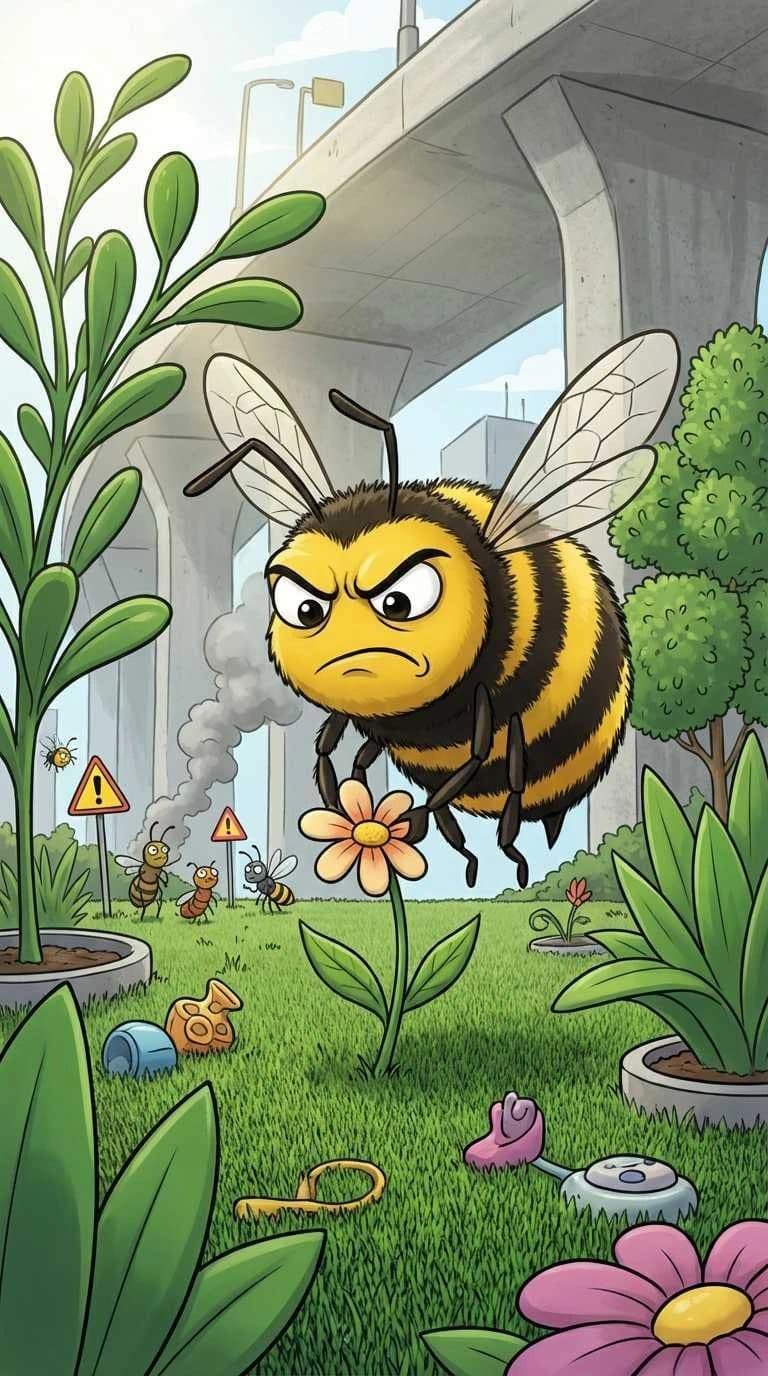
Grumble the Humble Bumble Bee
"You know what really bugs me?"
Routine.
Not because routine is bad. Routine is excellent. Routine is a warm, predictable tunnel you can fly through with your eyes half-closed and your brain fully dedicated to judging the scenery.
Routine is: Wake up. Pollinate the correct amount of flowers. Grumble at inefficiencies. Return to the hive. Repeat until the sun explodes or someone invents a better system. (They won't.)
So that morning, I woke up ready to do exactly that.
I stretched my legs. I shook out my wings. I did the antenna twitch that says: I am emotionally prepared to be disappointed by everyone.
Then I opened my eyes and the day immediately broke all the rules.
The Morning Squeal
First sign: the hive's morning hum was not a hum. It was a squeal.
Not a literal squeal. Bees do not squeal. We buzz with dignity. This was the buzzing equivalent of a room full of adults realizing the cake is still batter and the party starts in eight minutes.
Second sign: the air smelled wrong. Not wrong like smoke. Wrong like unfinished. Like someone promised spring and delivered an early draft.
I rolled out of my resting nook and nearly collided with a nursery bee barreling down the corridor like her wings ran on panic and caffeine.
"Bumble!" she barked, skidding to a stop. Her fuzz was ruffled. Her eyes were wide in the way responsible bees get when they can see the future and it is hungry.
"What," I said, "did you do."
"I didn't do anything!" she snapped. "That's the problem!"
Never trust a sentence that starts with I didn't do anything. That sentence is always followed by consequences.
Behind her, nursery bees fluttered in and out like they were running an emergency room made of wax and dread.
"We need pollen early," she said. "The larvae are due for feeding. The next generation is—"
"Yes," I interrupted, waving a leg. "The next generation is important. The next generation is always important. The next generation is the reason my wings are one long complaint."
She jabbed a leg toward the entrance tunnel. "The wildflowers haven't bloomed."
I paused. My brain tried to reject that information on principle.
"Haven't bloomed," I repeated, slowly, like careful pronunciation might make it less insulting.
"They're late," she said. "The orchard is swamped. Everyone went there because it's the only thing showing color, and now it's a traffic jam with wings."
"Of course it is," I muttered. "If there's one thing bees love, it's overcrowding. We cannot resist a bottleneck."
She took a breath like she'd been saving the worst for last. "The butterflies scheduled their migration event today."
I stared at her. No blinking. No buzzing. Just the steady horror of a bee hearing the words butterfly and schedule in the same sentence.
"...Their what," I said.
"The Great Flutter Forward," she recited, dead inside. "A celebration of movement and intention."
I felt a headache form behind my eyes, which is impressive, because my head is mostly determination and spite.
She continued. "It's happening the same day as the Annual Clover Refill."
I closed my eyes. Not because I was overwhelmed. Because I was trying to spiritually leave my body.
The Annual Clover Refill is not a party. It is not optional. It is not a vibe. It is a schedule-critical operation where we keep the clover patch — our reliable, no-drama food source — in rotation and protected from being trampled, mowed, or "improved" by humans with landscaping ideas.
It is pantry maintenance. Skip it and you starve later.
I opened my eyes again and sighed so hard my wings drooped.
"Well," I muttered. "That's great."
The nursery bee crossed her arms. "So you'll adjust your schedule?"
I laughed. Not a cheerful laugh. A laugh like a door slamming in a hallway.
"I will do no such thing," I said. "My schedule is a masterpiece. It is the only stable thing in a world built entirely out of chaos and poor decision-making."
She leaned forward. "Bumble."
"No," I said. "I am not—"
"Bumble."
"I am not reorganizing my day because flowers cannot keep up with their responsibilities and butterflies want to host an interpretive parade."
Her eyes narrowed. Then she said the one sentence that always works, because it isn't emotional. It's mechanical.
"If you don't adjust," she said, "the larvae don't eat."
The Part Where I Care (Against My Will)
I froze.
There are many things I can tolerate. I can tolerate nonsense. I can tolerate bureaucracy. I can tolerate butterflies using the word intention as if intention is edible.
I cannot tolerate preventable harm.
That's my problem. I care. Deeply. Annoyingly. Against my will.
My wings started a low, furious buzz.
"...Fine," I said. "I'll adjust."
Her shoulders sagged with relief.
"Not because you asked," I added quickly. "Not because it's noble. Because the alternative is unbearable and everyone else appears committed to learning nothing ever."
The Orchard Jam
I launched into the morning air like a grumpy bullet.
Outside, the field looked hesitant. The sky was bright, yet the light felt thin, like it was being rationed. The wildflower patch sat there with buds still clenched tight, as if blooming was an emotional commitment and the flowers were not ready to be vulnerable.
I flew down and landed on a bud that should have been open by now. It did not open. It sat there like a closed fist.
"Excuse me," I said, tapping it with my front leg. Tap tap. "Hello. You have a job."
The bud remained silent. I tapped harder. Nothing.
I leaned in until my face was basically pressed against the future flower.
"You have one purpose," I whispered. "You are not complicated. This is not a debate."
Still nothing.
Another bee landed. Then another. Then four more. We stared at the unopened buds like they had personally betrayed us.
One of them, young and earnest and tragically optimistic, said, "Maybe if we encourage them—"
"Don't," I snapped. "Don't talk to them like they're shy. They're plants. They are either open or closed. Encouragement is for children and butterflies."
No wildflowers. Plan B: orchard.
I could hear it before I reached it. A roar of wings. A thick, congested cloud of bees circling the trees like a storm made of fuzz and impatience. Everyone was trying to land on the same few blossoms that opened early, and the air was full of near-collisions, frustrated swerves, and the occasional indignant "Hey!" which in bee language translates to: I am the main character.
Then I saw the Ant Brigade.
Officer Formic perched on a branch like a tiny general, pointing at blossoms and barking instructions like he was directing traffic.
"Single file!" he shouted. "Maintain spacing! Pollination occurs in an orderly fashion! No cutting! No hovering!"
An ant beside him held a sign:
ORCHARD POLLINATION QUEUE PLEASE WAIT YOUR TURN FORMS AVAILABLE UPON REQUEST
I hovered there, watching bees ricochet like they'd all graduated from the same school of poor coordination.
I landed on the branch beside Officer Formic.
"Why," I said, "are you in charge of this."
He saluted. "Crisis management."
"This is not a crisis," I said. "This is what happens when everyone makes the same decision at the same time."
"Yes," he replied, pleased. "A crisis of coordination."
He unfurled a leaf. "We have proposed a solution: scheduled time slots."
My soul attempted to crawl out of my thorax.
"You want to solve bloom scarcity with appointments."
"It's efficient," he said. "If bees simply adhere to their assigned windows—"
"Bees don't do windows," I snapped. "We do weather. We do bloom timing. We do reality."
The Butterfly Problem
Reality chose that moment to land beside us in the form of a butterfly.
"Oh good!" she chirped. "Everyone's here!"
She wore a tiny ribbon that said FLUTTER FORWARD STAFF. More butterflies floated nearby arranging petals into a looping spiral. It looked beautiful. It also looked like a disaster.
"Bumble!" she said brightly. "Isn't it exciting? We're doing the migration today!"
"Why," I said, "today."
"Because it's symbolic," she said. "It's about movement and change and—"
"Movement and change are exactly what I am doing against my will," I said. "Congratulations."
She fluttered as if I'd complimented her.
"We're starting with a ceremonial flyover of the clover patch!" she added.
I went very still.
The clover patch is the pantry. The infrastructure. The thing that keeps the hive fed when everyone else is busy being poetic.
Butterflies wanted to do a ceremonial flyover. Butterfly for: we are going to be in the way and then act surprised that consequences exist.
"No," I said.
She blinked. "No?"
"No," I repeated, louder. "You cannot schedule your floating art project on top of our food infrastructure."
Her eyes widened with wounded sincerity. "It's for awareness."
"Awareness," I said, dangerously calm, "does not feed larvae."
Officer Formic perked up. "If you'd like, we can submit a petition to reschedule. Processing time is estimated at—"
I looked at him in a way that could curdle nectar.
"Listen," I said to the butterfly, lowering my voice the way you do when you're speaking to someone who thinks vibes are a substitute for logistics. "You can still migrate today. You're butterflies. You were going to migrate anyway. I am not denying you your... floating."
She brightened.
"You're not doing it over the clover patch," I continued. "You're doing it over the creek line."
Her face fell. "The creek line is less scenic."
"The creek line has fewer bees trying to prevent famine," I said. "That makes it scenic in the sense that it contains fewer emergencies."
She opened her mouth.
I raised a leg. "Before you say 'tradition,' remember this: tradition is just peer pressure from dead insects."
Officer Formic scribbled that down like it was scripture.
The butterfly hesitated, then nodded with theatrical suffering. "Fine," she said. "We'll redirect."
She fluttered away shouting, "Change is beautiful!" as if she'd invented it.
Solving the Jam
One problem moved. Orchard jam was next.
I hovered above the congestion and let my patience evaporate into the air.
"Okay!" I shouted. "Everyone hover. Stop. STOP."
Some bees stopped. Most didn't. One bee bumped into a blossom, spun, and yelled "Sorry!" like that fixed anything.
I landed on a high branch and yelled again. "STOP!"
Enough bees paused that chaos thinned into aggressive confusion.
I pointed with my whole body, because subtlety is wasted on crowds.
"Orchard is at capacity," I said. "You're wasting energy hovering here. Energy is food. Food is larvae. Larvae are the future. Move."
A bee shouted, "There are blossoms here!"
"There are blossoms elsewhere," I snapped, "that you're ignoring because they're not trendy."
Blank stares.
I did something I hate. I explained.
"Dandelions," I said. "Early clover edges. The weeds humans hate. Anything open. Anything with pollen. Bring back even a little. The nursery bees can start feeding. That buys us time until the wildflowers stop sulking."
Someone muttered, "The schedule—"
"The schedule is dead," I said. "Long live the schedule."
Officer Formic raised a leaf. "Are you issuing an official directive?"
"I am issuing reality," I said. "It does not come with forms."
Life chose that moment to humble me.
I hopped to demonstrate a route marker on the branch, slipped on a slick patch of bark, and slid down the limb like a fuzzy pebble.
I caught myself at the last second, dangling upside down, legs flailing.
There was a beat of silence.
A bee whispered, "Is that part of the plan?"
I swung back up with a furious flap. "Yes," I lied. "It's called urgency. You should try it."
They moved. Not because my logic was flawless. Movement is contagious. No one wants to be the last bee hovering in a jam.
They peeled off toward lesser-loved blooms. The orchard air cleared. The remaining bees landed cleanly. Blossoms got pollinated without collisions.
The entire system improved because someone finally said out loud that the obvious thing was obvious. Which should not be a heroic act. Yet here we are.
Enough
Now: the clover patch.
I flew back hard, cutting across the field with the speed of someone who has accepted he will not enjoy today.
The butterflies had redirected, thank the sun. Their glittering ribbon now drifted over the creek line, beautiful and completely unaware of how close they came to being the villains.
The clover patch was full of worker bees doing the Annual Clover Refill. Checking blooms. Guarding edges. Preventing human interference. Doing the work that nobody notices until it fails.
The nursery bee hovered near the entrance, looking like she'd been holding her breath for hours.
I landed beside her and dropped a small pollen bundle I'd grabbed from an unloved patch of dandelions on the way.
It wasn't glamorous. It wasn't abundant. It was enough.
Her eyes softened. "That will help."
"It will have to," I said.
She studied me. "You adjusted your schedule."
"I adjusted reality," I corrected. "The schedule was being delusional."
She smiled. "Thank you."
My skin crawled.
"Don't," I warned. "Praise summons responsibilities."
She laughed, which was rude, because she knew I was right.
I lifted off again, wings aching.
Wildflowers would bloom eventually. Orchard traffic would stabilize. Butterflies would flutter into tomorrow with zero memory of inconvenience.
My routine, my precious warm predictable tunnel, was gone. Replaced by a better one. Which is somehow worse, emotionally. Because now I couldn't pretend the old schedule was the only way.
I changed it. It helped.
That is the problem with being someone who serves. If you see the problem, you have to fix it. Even if you don't want to. Especially if you don't want to.
As I flew back toward the hive, I muttered the only thing that felt true:
"Flexibility," I grumbled, "is just responsibility wearing gym clothes."