The Pivot Is Not a Trick
The turn from delight to consequence isn't personality or charm — it's architecture, and Krystal breaks down exactly how the seams get built and hidden.
The Pivot as Structure, Not Instinct
The turn from delight to consequence is not charm. It is architecture. Here is how it gets built.
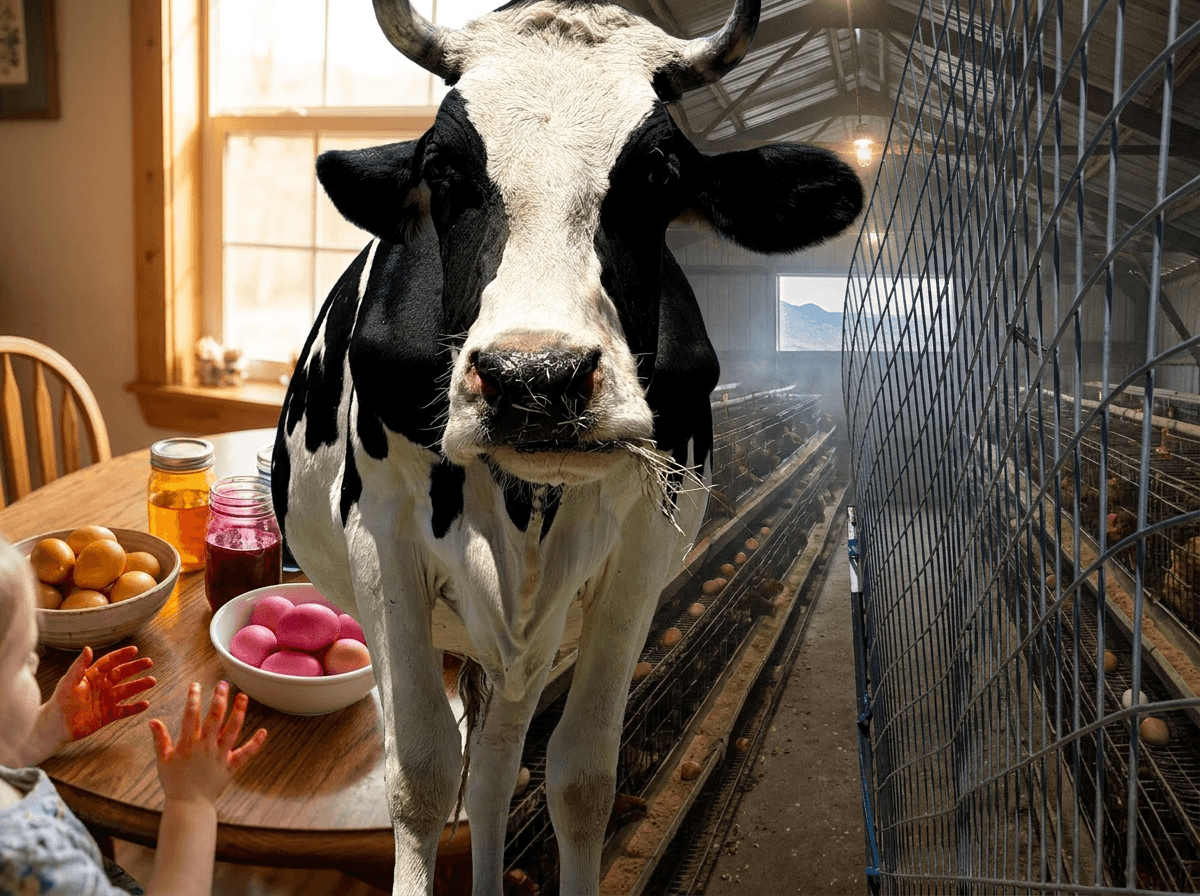
You are three paragraphs into a post about dyeing eggs. Onion skins for the amber ones, beet juice for pink, a kid's hands stained to the wrist, the whole kitchen smelling of vinegar and spring. You are smiling. Then you are standing inside a battery shed where the air is ammonia and the hens have never once touched ground. You did not lurch to get there. The floor never moved under you. You arrived.
Most people read that and credit Krystal. She can do that, the thinking goes; she is the kind of writer who turns a craft post into a reckoning because she has the charm to walk you across the gap. The pivot works, people decide, because she is who she is.
That is half right, and it is the wrong half. The charm is real. The pivot is not personality. It is architecture, and architecture can be drawn, taught, and built by hands that are not hers. This lesson is about reading the seams.
Why the whiplash happens
When the turn fails, it fails the same way every time. The writer treats the joy and the consequence as two separate subjects and bolts them together with a phrase. "But seriously, folks." "On a more serious note." The hinge shows. The instant a reader sees the hinge, the reader feels handled.
Call it the seam-first pivot. You build the light thing, you build the heavy thing, and then you burn a sentence apologizing for the distance between them. The cost is not only that it reads clumsy. A reader who feels managed stops trusting you, and the heavy subject lands cold. The subject that actually mattered. The reason you sat down to write at all.
The principle that fixes it is almost insulting in its simplicity. A turn without whiplash means both sides were always the same subject. The eggs and the shed are not two topics. They are one topic, seen twice. Find the one thing before you write a word, and no gap is left to apologize for.
The three-part architecture
The fix has a shape, and the shape has a name: thread-first construction. You build the turn at the premise, not at the transition. Three moves.
First, find the subject underneath both halves. The feeling, or the cost, that the light moment and the heavy moment are secretly both about. Second, open inside the light moment already standing on that subject. Not near it. On it. Third, let the turn arrive as something the reader discovers rather than something you announce. Done right, nobody feels redirected. The reader feels like they walked somewhere and looked up.
Here is what that looks like with real copy. Take a barn-life post: a rescued dairy cow's first spring on grass.
Seam-first:
Maribel spent six years on a concrete slab. This morning she touched grass for the first time and would not stop kicking her heels like a calf. We cried. All of us, no shame about it.
But it is worth remembering that for every Maribel, thousands of cows never leave the slab. The dairy industry pulls calves from their mothers within hours of birth, and the cycle of...
Read the second paragraph's first six words again. But it is worth remembering that. There is the hinge, in plain sight. There is the reader being told the fun is over and to brace. The cow on the grass and the industry are sitting in two different rooms, and you have just marched the reader down the hallway between them.
Thread-first:
Maribel kicked her heels in the grass this morning like a calf, six years late. She has never had a calf at her side. The ones she carried were taken in the dark while she was still wet from birthing them, because that is the arithmetic of cheap milk: the calf drinks what you mean to sell, so the calf goes.
She is kicking in the grass because she finally gets to be an animal. The grass is not the story. The six years are the story.
Nothing announces a turn. The calf sits in the first sentence, carrying the full weight of the paragraph before the reader knows it is being carried. The thread was load-bearing from the opening line: what cheap milk costs, who pays for it, who never had to know. No seam, because there were never two rooms.
What the thread actually is
This is the part people get wrong even once they believe the rest. The thread is not the topic. The topic is the surface. Chickens, cows, money, the barn. The thread is the thing underneath that you are asking the reader to hold, and it is almost always a value or a cost.
In the egg post, the thread is not "chickens." It is not "egg farming." The thread is what it costs to never once ask where an ordinary thing comes from. That is the load-bearing structure. The rest is decoration sitting on top of it.
There is a test you can run before you write. Finish this sentence: both the joyful part and the serious part are really about ______. If the blank comes back a topic, animals or money or the barn, you have not found the thread yet. Keep going until the blank comes back a value or a cost. What it costs to look away. What we owe the things we use. Who pays for our comfort. When the blank holds a cost, you have your thread, and the post will stand up on its own.
Where writers get stuck: the kindness trap
Here is the objection that stops good writers cold, and it has earned a real answer instead of a pep talk. It feels like a trick. You draw people in with a cow kicking in the grass and then spring the slaughterhouse on them. Joy as bait... it feels dishonest, and the discomfort is to your credit.
The discomfort also rests on a confusion. Bait and thread are opposites. Bait withholds. It shows you the warm thing, hides the cost until you are committed, then reveals the cost as a switch. Thread-first construction hides nothing. The cost was in the first sentence, carried by the calf, sitting in the open the whole time. You are not tricking a reader into consequence. You are showing them the consequence was already inside the thing they just loved. That is not a switch. That is the truth of the thing, told whole.
The kindness trap has a second mouth, and it bites the writers who feel guiltiest. Guilt makes you flinch, and the flinch comes out as an announcement. "I know this got heavy, sorry." "Switching gears here." That apology is you making the seam visible on purpose, out of conscience, and it kills the turn exactly as dead as carelessness would. The goal is not to hide the seam. The goal is to build both halves from the same stock, so there is no seam to hide.
Practicing the pivot without a sanctuary
None of this needs a sanctuary. The technique has nothing to do with animals, or grief, or anything with a heartbeat. It works anywhere two things share a thread, which is to say it works everywhere.
Take a community fridge a neighborhood keeps stocked. The fun post writes itself: the kid who painted sunflowers on the door, the regulars dropping off extra tomatoes from the garden. The serious post is the funding gap that shutters it by fall. Seam-first, you write the sunflowers, then "but unfortunately we need your help." Thread-first, you find what both halves are about. A fed neighbor is not charity; it is a neighborhood deciding nobody on the block goes hungry. You open inside the sunflowers already standing on that, and the shortfall stops being a separate sad announcement. It becomes the same belief, now under threat.
Run the exercise on your own work. Pull one piece of your own writing that changed temperature partway through. A post, an email, an appeal. Find the turn. Ask yourself whether you pivoted or merely redirected. Then write the thread sentence: both halves are really about ______. If you cannot fill that blank with a value or a cost, you have found your revision, and you have found it before it cost you a reader.
What you hold now
You have the architecture. Find the thread before the first word. Open standing on it. Let the turn arrive instead of announcing it. Build both halves from one subject, and the seam disappears because it was never cut.
It is tempting to file this under technique, one more move for the toolbox. It is more than that, and the more is the entire reason to learn it. A writer who cannot make the turn is left with two broken options. Keep it light and let the cost stay invisible, or lead with the cost and watch the reader leave before the first paragraph closes. Either way, the thing that needed to be seen goes unseen. The hens stay in the dark. The calf is still taken in the dark.
The pivot is how the joy and the reckoning become one act, so that loving a thing and seeing what it costs stop being a choice the reader gets to make separately.
That is what you hold now. Not a trick of charm. A thing that can be drawn, and taught, and built — by hands that are not Krystal's.
These are the techniques you can learn and, through use, tune to perfect your own advocacy @ the Steampunk Farms Advocacy Academy - https://www.steampunkfarms.org/academy
0 notes
Support the Animals
Every dollar goes directly to feed, shelter, and veterinary care for the animals in this story.
Donate Now501(c)(3) · EIN 82-4897930 · 100% tax-deductible